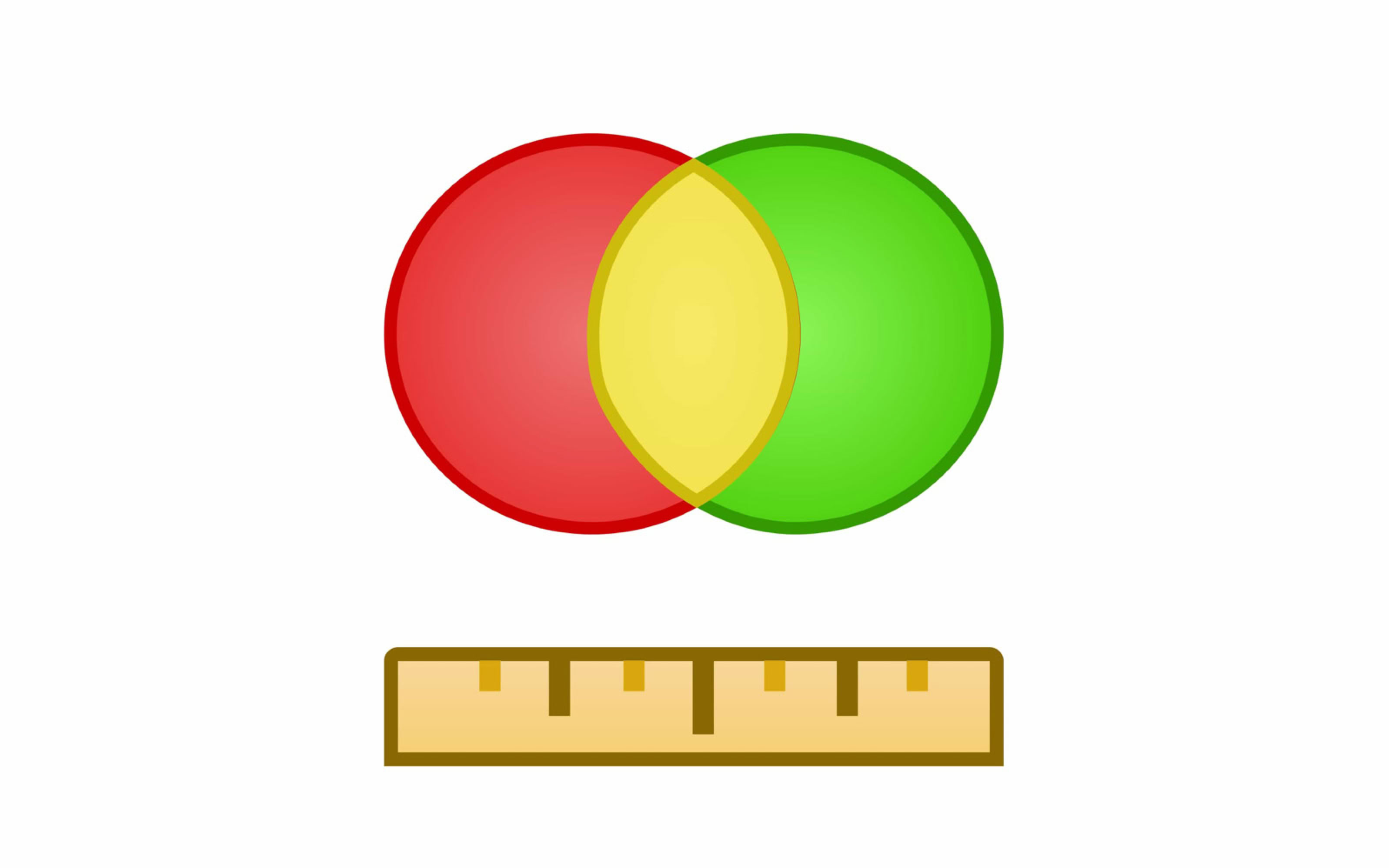
When studying colocalization, it is essential to understand that its quantification reflects several visual phenomena, primarily co-occurrence and correlation. Co-occurrence measures the spatial overlap between two fluorophores, while correlation assesses the degree to which the extent of overlap between the two fluorophores is related. Both measurements have distinct strengths and weaknesses.
Different coefficients are used to quantify these two phenomena. Co-occurrence is expressed using the overlap coefficient (R), according to Manders (MOC), with a range from 0 to 1. Correlation is quantified by Pearson’s correlation coefficient (Rr) (PCC), which ranges from -1.0 to 1.0.
The selection of a specific coefficient depends on the biological processes under investigation and the technical limitations of colocalization experiments.
Co-occurrence measurements are particularly useful for determining the proportion of a molecule present within a specific region of interest (ROI), compartment, or organelle. However, it does not provide insight into the concentration relationship between two molecules.
On the other hand, correlation is most appropriate for evaluating the functional or stoichiometric relationship between two overlapping molecules, although it does not measure the extent of spatial co-occurrence.
Co-occurrence and correlation can be observed simultaneously and independently, with the extent of either phenomenon largely determined by the underlying biological behavior. Additionally, one must consider the properties of the analyzed images. MOC values may be erroneously inflated due to out-of-focus light and background fluorescence, while PCC values may be less reliable for images with a low signal-to-noise ratio.
When quantifying colocalization, it is crucial to consider the specific biological question at hand and account for potential technical issues with the analyzed images. Both co-occurrence and correlation measurements of colocalization can provide complementary insights into a biological system, but they should be carefully selected for the appropriate tasks.