Colocalization refers to the presence of two or more differently colored fluorescently labeled molecules at the same location. This means that the colors they emit occupy the same pixel in the image. From a biological perspective, it indicates that two or more different molecules are attached to the same structure within the cell. In digital imaging, it is described as the spatial overlap of two or more dyes in a multichannel image.
The information about distinct molecules appearing at the same location can be highly significant to researchers. For example, a common question might be, "Does protein A overlap/colocalize with protein B, and if so to which degree?”. Quantitative colocalization provides a clear answer to such questions
To ensure that your colocalization images are suitable for quantitative analysis, it is important to follow specific colocalization guidelines. Neglecting these guidelines may compromise the reliability of quantitative colocalization analysis or even render your confocal images unusable for this purpose.
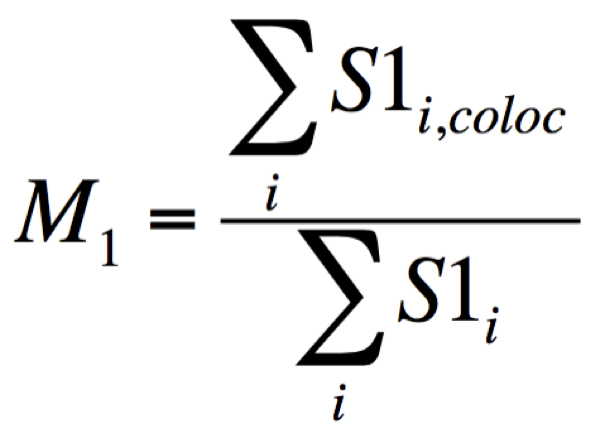
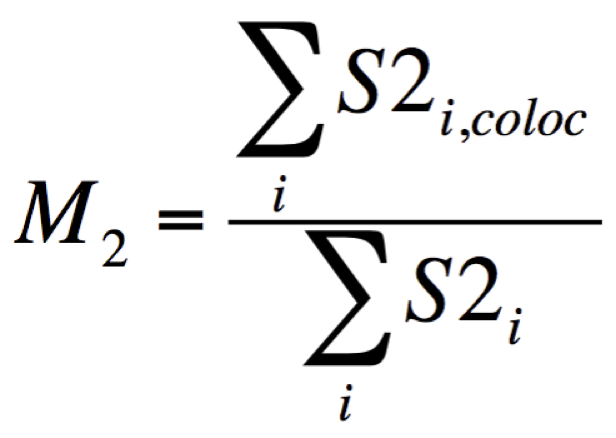
Colocalizer apps assess colocalization by calculating values that represent the proportion of colocalized pixels in dual-color fluorescence microscopy images. These values are known as colocalization coefficients.
An interpretation table for the results of colocalization coefficient calculations can help you better understand your data.
Coefficients calculated by CoLocalizer and their significance
Pearson's correlation coefficient (Rr) is a standard measure in pattern recognition. It describes the correlation of intensity distributions between channels, focusing on similarities in shapes while ignoring the intensities of signals:

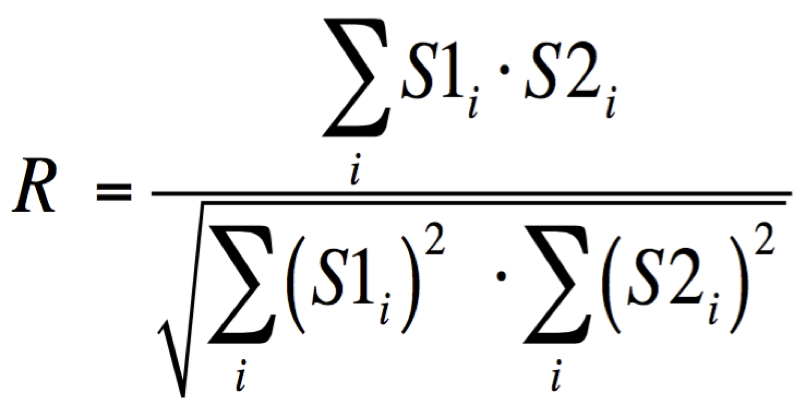
Manders’ overlap coefficient (R) indicates the overlap of signals. This coefficient is not affected by limitations of typical fluorescence imaging, such as hybridization efficiency, sample photobleaching, and camera quantum efficiency:
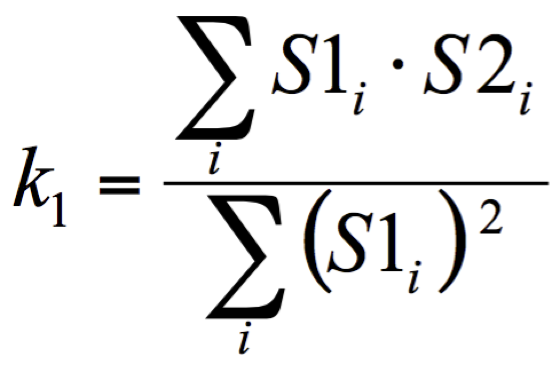
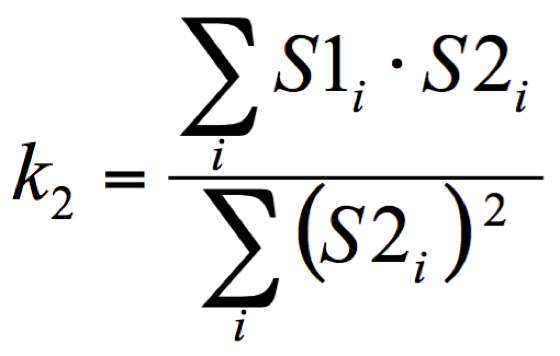
Overlap coefficients (k1 and k2) divide the value of colocalization into two distinct parameters. These coefficients are calculated based on the sum of the products of the intensities from two channels and are particularly sensitive to variations in signal intensities:
Colocalization coefficients (m1 and m2) indicate the contribution of each channel to the image region of interest (ROI). They are not influenced by signal intensities and are applicable when the number of objects differs:
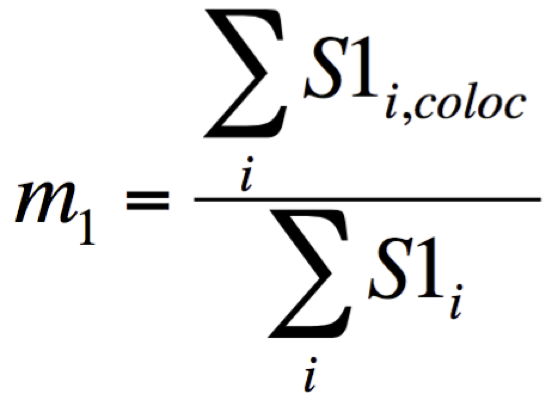

Colocalization coefficients (M1 and M2) indicate the contribution of each channel to the image region of interest (ROI). They are not influenced by signal intensities and are applicable when the number of objects differs: